 |
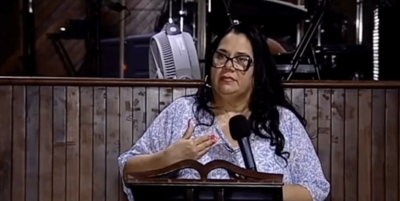
| Pastor Iris Nanette Torres |
A video recently surfaced on social media showing Pastor Iris N. Torres, a Pentecostal leader from Bayamón, Puerto Rico, and head of the church El Caballero de la Cruz (“The Knight of the Cross”). In the video, she endorsed Donald Trump’s immigration policies and questioned why people felt so “alarmed” by immigration raids.
Her words weren’t just blunt—they revealed profound insensitivity and privilege.
As a U.S. citizen by birth, Torres has never faced immigration interviews, ICE raids, or the looming threat of deportation. Her congregation likely doesn’t include undocumented people, which may explain why she spoke so carelessly—reducing immigration to a legal matter and ignoring the human suffering behind it.
In 2019, her church claimed a weekly attendance of 2,700 people. But religious institutions often inflate those numbers. Sociologists of religion have long documented how megachurches include casual visitors and media viewers in their counts.
The Hartford Institute for Religion Research confirms that these churches rarely track meaningful engagement. They often report high numbers to attract donors and justify growth. In reality, the number of committed congregants is likely much lower.
Torres’s rhetoric reflects a broader trend among conservative evangelical churches in the U.S.: a shift from compassion to legalism. Instead of defending the vulnerable, they exalt the law—even when that law is cruel.
People forget that legal systems once upheld slavery, racial segregation, colonialism, and arbitrary detention. Instead of challenging unjust power, Torres spiritualizes punishment. She uses the Bible to control, not to protect.
The irony deepens when we recall that Jesus himself was a refugee. According to Matthew 2:13-15, his parents fled with him to Egypt to escape a government-ordered massacre. Torres seems to forget that ancient borders existed—and Egypt was a different nation.
By today’s standards, Jesus would be an undocumented child seeking asylum. Many Christian communities throughout history have recognized that and stood with migrants. But Torres promotes a theology that replaces that memory with nationalism and fear.
Her support for Trump and her lack of empathy toward undocumented people reveal something dangerous: the merging of faith, political power, and legalistic supremacy. That’s not just about her opinion. It shows how religion can uphold systems of exclusion, racism, and state violence—the same logic that once defended slavery, patriarchy, and colonialism.
After public backlash, Torres tried to walk back her statements. On the Christian radio show Temprano en la Mañana (“Early in the Morning”), she said people had misunderstood her. She claimed she didn’t want to report anyone to immigration authorities and only meant to encourage people to regularize their status. Still, she admitted she had mentioned ICE and Homeland Security in her original remarks. And she insisted, “I can’t support any kind of illegality.”
Her retraction didn’t deny what she said. It only softened it. From a critical perspective, she didn’t apologize—she deflected. She tried to manage the fallout, not to reflect morally. In theology, as in politics, words matter. And so does the power behind them.
During a course on conflict transformation at the Boston University School of Theology, Professor Judith Olsen once said, “Christianity is a source of both peace and conflict, of justice and oppression, of unity and division.” I never forgot that. It highlights the double standards prevalent among many religious leaders today. Torres speaks from that tension—using faith not to heal, but to condemn.
Boston University treated me well. The school awarded me scholarships and stipends for my leadership in a low-income neighborhood in Boston. But despite that support, I couldn’t stay. I saw Christianity’s profound contradiction—its historic swing between liberation and domination, welcome and exclusion. I left not because of a faith crisis, but because I gained clarity.
That’s why I don’t just question what Torres said. I doubt the pulpit she stands on—one that no longer offers refuge, but echoes the cruelty of a broken system.
Comments
Post a Comment